Here We Go Again Gif Dbz
 | Part 1 | Office 2 | Part 3 | Role 4 | Part 5 |
Here we become once again. I was seriously planning not to blog once again about non-fungible tokens (NFTs), and instead concentrate on writing a full academic newspaper well-nigh the subject area, but events have overtaken us, and it seems similar a day in NFT-state is similar a month in the real world, much similar time has become irrelevant in the pandemic, but I digress.
So much has happened in the final week that it's difficult to keep up. Jack Dorsey sold an NFT of his commencement tweet to a crypto entrepreneur for an equivalent $2.5 1000000 USD, beating another crypto entrepreneur. The NBA had been selling NBA Pinnacle Shots, "unique" NFTs of NBA moments, the value of which exploded with the rest of the scene. Then an NFT of a collage of works of digital artist Beeple was placed at auction at Christie's and it was purchased by another crypto entrepreneur for the middle-watering sum of almost $70 one thousand thousand USD, and all hell broke loose. Astute observers of the space have noticed that the buyer of the Beeple NFT already owned several tokens on other works, prompting questions nearly the validity of the value beingness exchanged in this space. In brusque, most of the activeness seems to consist at the moment of crypto-bros buying stuff off each other, adding to the hype and farther inflating the market. Simply I digress again.
The incredible hype has brought almost a gilded rush in which everything is beingness tokenized and released every bit an NFT, so information technology was but a matter of time until someone tokenized something that didn't belong to them, or something in the public domain. That time has just passed.
A few things have been happening in this front. Offset, a few artists started noticing that some of their art was being tokenized without their permission. This was to be expected, as the hype grows, the incentives to put something up for sale also increases, fifty-fifty if what is being tokenized doesn't belong to the poster.
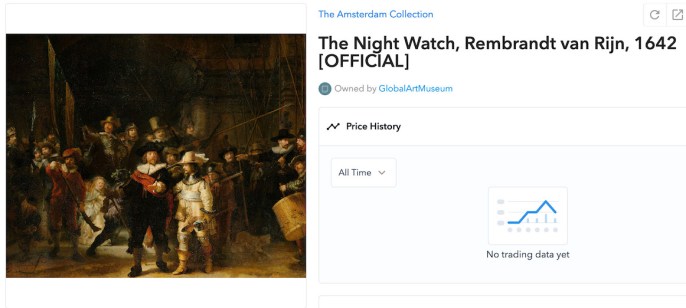
And now another inevitable and foreseen affair has happened. An entity known every bit the Global Fine art Museum (GAM) has started tokenizing public domain works and placing them for auction in the NFT marketplace OpenSea. GAM is "an fine art initiative that aims to transform chiliad Old Masters, from the Renaissance to Neoclassicism, into NFTs." They claim that each painting is unique in the collection, and that 10% of sales volition get to the museum.
This has generated a bit of a small twitterstorm, and information technology will be interesting to see what happens. Yet, this raises quite a lot of potentially interesting legal questions that I have not seen answered elsewhere. The first question is well-nigh the validity of making NFTs out of public domain works, and whether this is some form of copyfraud. The 2d is that of possible copyright infringement taking place in the NFT space. I will deal with each question separately. However, first we need to look at the underlying applied science.
Minting a work
This question is related to what actually happens when a work is fabricated into an NFT. I explained a chip well-nigh tokens in my previous web log mail, just with possible copyright infringement and copyfraud claims taking identify, we actually need to look a little bit closer at what is happening under the hood when an NFT is created.
 When we remove all of the hype, an NFT is really zippo more than than metadata written into a blockchain. There are many ways of doing this, you can even test it yourself past installing a local ethereum node in your figurer, downloading an NFT form contract, and applying it to a file in your estimator and compiling it following i of the many tutorials out there that will let you to create a local NFT (it'due south sort of easier than it seems). The resulting data tin can exist written into a blockchain, which requires access to a cryptocurrency wallet that tin can transact in the target blockchain (almost likely Ethereum).
 So assuming we want to mint an icon of a equus caballus (these examples were created by programmer Andrew Coathup), and you have an Ethereum wallet and funds, you tin install an implementation of the ERC721 contract in your computer, and employ the file to compile a contract which produces metadata that can be written to the Ehtereum blockchain, as is the case with this horse here. This metadata is using standards that are publicly verified and verifiable, so other intermediaries can just look at the data and meet that this is a valid NFT. Considering this metadata was encoded with a file and a set of private keys and private accounts, the resulting token is unique and intrinsically encoded with the original file.

You may observe one affair about all of the above, which I think may be important when nosotros analyse the upshot from a legal perspective, and information technology is that while the epitome of the horse was used to encode the NFT and make information technology uniquely attached to the paradigm, the NFT is not the actual paradigm itself, it is the metadata that ties it to the original file. This is an important point that I feel is as well beingness missed in some of the media coverage of NFTs. In some ways, it seems like what is being bought is a work of art, or a tweet, or a video, but that is not correct, what people are purchasing is a unique receipt written into the blockchain.
Many of you will see one of the starting time glaring aspects of the vaunted scarcity that is being created here, and information technology is that null stops me from making another unique metadata of the same piece of work, the resulting data will be uniquely tied to the original, just there'south zilch stopping me from creating diverse versions of dissimilar metadata from the same image. In fact, I could even just re-size it by one pixel, and besides produce all sort of "unique" metadata of the same thing, or of a different format of the same image.
The 2d thing is that one tin can add all sort of copyright related data into the contract and include it in the encoding of the file, just this once more is just a claim that is written by the minter, information technology doesn't make it true, and it is not a claim of belongings. One owns the NFT because one owns the keys that were used to mint information technology, and these can exist transferred. At that place is a lot of misunderstanding of what the buying of the NFT ways, some people seem to remember that if you buy an NFT of an NBA shot, you own that clip, when in reality yous don't, the terms of the NBA NFT are hazy on that respect, and on whether there will be other versions of the clip made available, and you lot can't even really apply the image without permission.
Moreover, one does non demand to ain the original itself, anyone tin create an NFT of anything in the world, even if it doesn't vest to them. Which brings us to the questions of copyfraud and copyright infringement.
Copyfraud
Copyfraud is generally understood as making a faux or dubious copyright claim over a work that is in the public domain. Works that are in the public domain can be used by anyone, but sometimes an institution volition brand a copyright claim over 1 such work. At that place is petty or no issue to copyfraud, to my knowledge only Chile has fabricated it a criminal offence to falsely make a copyright merits over a piece of work in the public domain, and there'south very niggling litigation on this subject. However, there has been some backlash against heritage institutions that have made dubious ownership claims involved with public domain works (unrelated note, I used to get more than comments in the blog!).
And then while there may not be a legal result with copyfraud taking place, we have to inquire if the tokenization of works by GAM is doing here even copyfraud. As we have seen above, when i makes an NFT of an image, one has to have an original file that is existence used to mint the token. In the case of GAM, they took artworks from the digital drove of public domain works at the Rijksmuseum in Amsterdam. This is a very famous and celebrated drove that has gone entirely digital, and nearly of it is flagged equally being in the public domain.

Plant at the bottom of all artwork.
The Rijkmuseum encourages re-uses of its works, and this is a strong political statement in defence force of the public domain. When visiting Rembrandt's The Night Watch, i is allowed to make prints of details, download the prototype to utilise in a new creation, and even to gild posters of the work. This is keeping with the idea that one should non enclose the public domain, it'due south for everyone to utilise. The copyright condition of the work is clearly ready equally being in the Public Domain, and while there could exist some claims over the photograph of the painting, it's unclear that it would meet a threshold for protection. The Rijksmuseum claims ownership of all the photographs of its artwork, just doesn't seem neat to enforce it.
Then the GAM projection had legitimate access to the Rijksmuseum works, and then there is no effect with regards to minting a work and turning it into an NFT, equally is the example with the aforementioned painting. 1 may not like the possible enclosing of a public domain piece of work, and personally I find the use of PD works in this way in order to turn a profit and make an NFT as rather distasteful, but it's definitely non illegal.
Furthermore, i could argue that what is being done hither is not even copyrfraud at all. GAM has made articulate that all the works come up from the Rijksmuseum, and do non claim any interest with the institution. What they have done is used an image, and I take to say a sort of depression quality re-create at that, and used information technology to mint some metadata and write information technology in the Ethereum blockchain.
And so at that place are no claims of ownership, just the minting of a "unique" version of the work which is non even a copy of the work itself. No copyfraud here.
Only then what's the point? Here is where I'yard more than critical. While legal, I find that the inevitable blitz to make an NFT out of all public domain works is a good indication of the vacuousness of the NFT scarcity idea. The people at GAM can mint Rembrandt's works, but so can I! I just can't be bothered to pay about $forty USD at today's prices to have the work minted. Moreover, the mythical uniqueness of this token still baffles me, it'southward just metadata. All files in the world are unique in 1 way or another, an NFT is but having a cryptographically signed version of it, and ane not even from the author (because, you know, public domain artists are no longer with us). So I can buy something and tell everyone that I ain an exclusive metadata, which anybody else can reproduce.
And so while my initial reaction was 1 of disgust, I have come up to run into information technology mostly as slightly unethical at worst, and pointless at best. There may fifty-fifty be a silverish lining, with all the corporeality of money flight around at the moment, information technology would not be the worst thing in the world if some of information technology fabricated information technology to a museum to proceed preserving the public domain. (edited to add together: apparently it was all a big joke!).
Copyright infringement
While the minting of public domain works is interesting, the event that is most likely to generate legal conflicts is the minting of a work from a person that is not its writer or owner. The other phenomenon taking place is that people have now started minting works that do not belong to them.
Artist WeirdUndead complained that someone had been minting their works and placing them in OpenSea, while another artist chosen CorbinRainbolt had some of his works on dinosaurs also tokenized without his permission.
In both instances works take been removed from the NFT marketplaces, but information technology prompts usa to ask the question of whether the unauthorised minting of a piece of work would actually exist copyright infringement.
I really call up that this is a trickier question than information technology would appear at first, and over again I revert to the way in which works become tokens. As explained above, you lot demand a file to digitally sign and turn it into a non-fungible token. This could be done with your own works, a photographer tin can practice this with a digital file of their pic, and an artist can exercise the same with their digital art. But what if I wanted to mint a piece of work by Beeple, or past Banksy? Who would exercise that? Well, I did, at least in a local blockchain using Ganache and Pinata (instructions on how to do this tin exist constitute hither).
I wrote a smart contract chosen PirateNFT and used it to compile an image by Banksy (I thought about using Beeple, but I actually dislike his fine art). So I uploaded the moving picture and a metadata file to Pinata, which added a hash to the work, and the metadata claims that I am Banksy. The next pace was done to compile the NFT locally putting everything together, in effect minting it to my local blockchain. In a real implementation I would exist minting it for real into a blockchain using either a third party service, or on my own (with the appropriate tools and wallets). Permit'due south imagine that I went the extra step and uploaded the metadata not only to a file service such as Pinata, but turned information technology into a full NFT in a public blockchain. Have I infringed copyright in some form? (Edited to add: I've gone ahead and minted the epitome).
For certain I downloaded the file from the Internet, and so went and produced some metadata that is intrinsically linked to it. While the file is online, it need not exist, an NFT is not the image itself, simply the tokenized version of the image. Is this unauthorised copying? Is it a communication to the public? I am not sure, as I said, my NFT is not the work itself, information technology is just a non-fungible token of it. My thinking right at present is that the NFT is non a communication to the public as long as a copy of the original hasn't been fabricated available, but I'm willing to heed to other people's ideas.
My pirate token likewise has some encoded metadata making false ownership claims, and that could possibly exist an infringement of the moral right of attribution, which may exist a meliorate avenue to pursue this.
Concluding
Nosotros really have not many answers, I tend to retrieve that edifice an NFT out of an image may not necessarily infringe copyright unless an infringing copy of the work has besides been uploaded and made available to the public. I likewise practise not think that making NFTs out of public domain is illegal in any sense. The public domain is for everyone to use (and abuse).
I do think strongly that the electric current craze is unsustainable both in a market place and environmental level. Until Ethereum moves away from Proof of Work, the environmental concerns most the waste of resources used in the cosmos of an NFT will not go abroad. I also think that NFTs volition lose their shine once people realise that what is being exchanged is not the work itself, or any ownership merits over the assets, and that there'due south nada stopping the token issuer from making more copies of their assets. I can't help just thinking that NFTs are a but a pound-shop version of DRMs, with added ecology end monetary expense.
Whatever happens, I may have to write another blog postal service next week at the current pace.
Source: https://www.technollama.co.uk/copyrfraud-and-copyright-infringement-in-nfts
0 Response to "Here We Go Again Gif Dbz"
Post a Comment